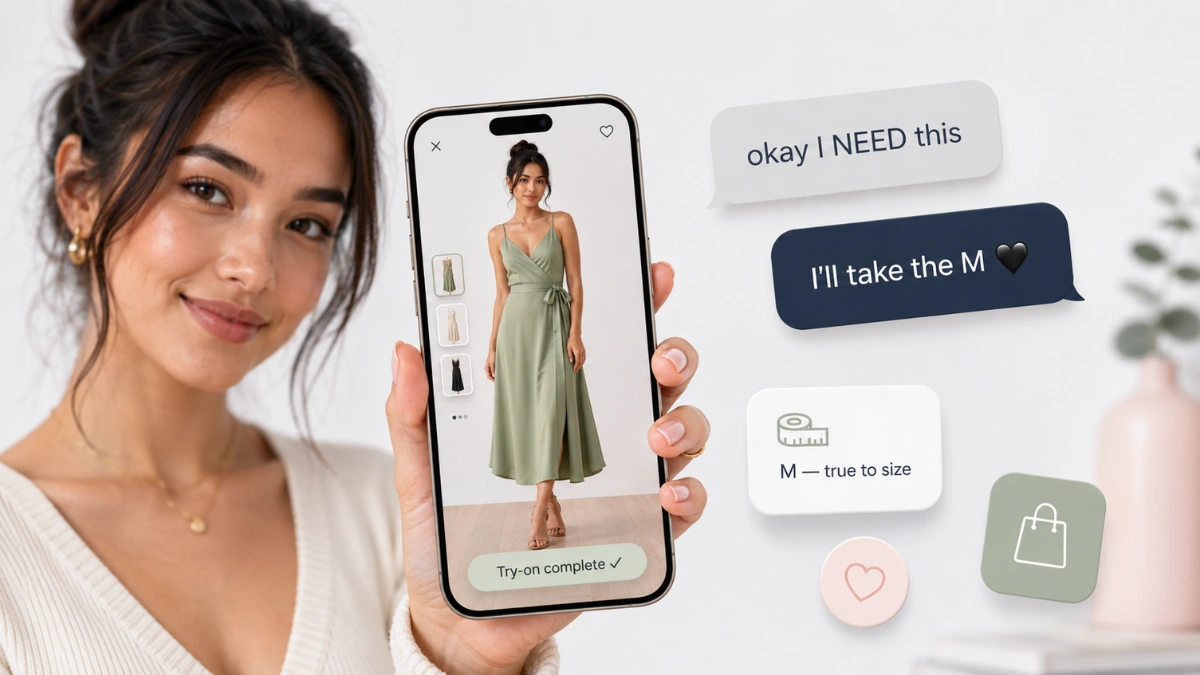
Selling clothes on Instagram looks simple from the outside: post nice photos, wait for the “is this still available?” messages, ship the orders. Anyone who has actually run an Instagram clothing shop knows the truth — the posting is the easy part. The hard part is everything between a follower double-tapping your photo and money arriving in your account: the twenty sizing questions per drop, the buyers who ghost mid-conversation, the returns from people who guessed wrong, and the constant pressure to produce fresh content.
This guide covers the full playbook — profile setup, content, the DM sales workflow, and the tools that remove the friction — whether you’re starting a thrift shop from your bedroom or running an established boutique account.
Step 1: Set Up a Profile That Sells While You Sleep
Your profile is your storefront window, and most selling accounts get it half right. The essentials:
Switch to a business or creator account. You get insights, contact buttons, and — critically — the ability to add a working link in your bio. Selling from a personal account means losing your single most valuable pixel of real estate.
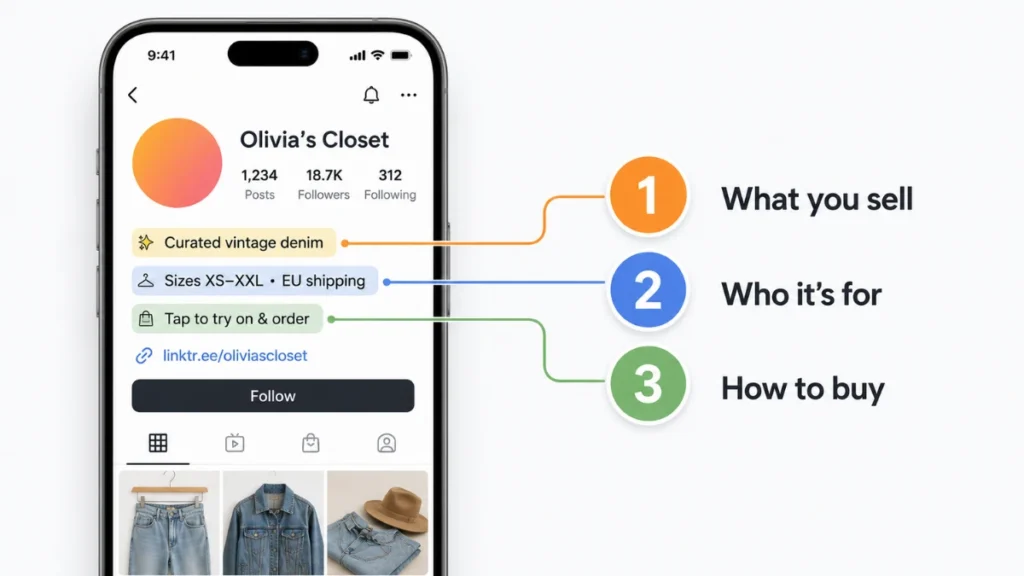
Write a bio that answers three questions in five seconds: what you sell, who it’s for, and how to buy. “Curated vintage denim • EU shipping • Tap the link to try on & order” beats a lifestyle quote every time.
Use your one link deliberately. This is the biggest decision on your profile, and “DM me to order” is not a strategy — it’s a bottleneck. The accounts that convert best send followers to a single destination where they can browse everything, check sizes, and start an order without waiting for you to answer. If you don’t have a website (and you don’t need one), a hosted storefront like the ones we build at AnyDress for Instagram sellers gives you a browsable shop with prices, size charts, and an AI fitting room — live in minutes, no hosting or code. You can also explore the AnyDress-Demo shop to see how your store could look and how shoppers will experience the virtual try-on feature.
Step 2: Solve the Photo Problem Before It Solves You
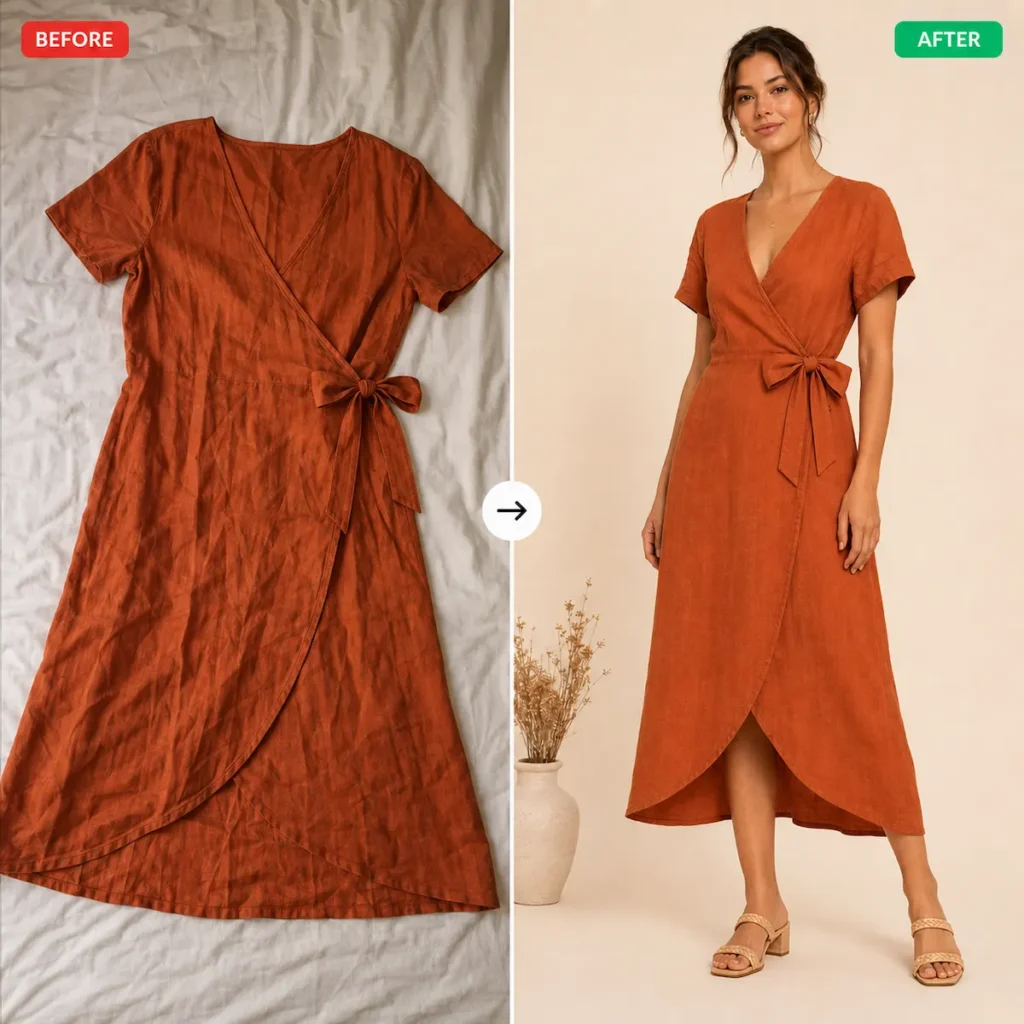
Clothing sells on visuals, and this is where most Instagram sellers hit a wall. You have three traditional options, all bad: model the pieces yourself (exhausting and limits your posting volume), hire models and a photographer (eats your margin), or post flat lays and hanger shots (which convert poorly, because nobody can picture themselves in a flat lay).
There’s now a fourth option: AI product photography. You photograph the garment once with your phone — on a hanger, on your bed, however — and AI generates studio-quality images of it on a model, on a ghost mannequin, or in any setting you describe. We’ve written a full guide to how AI clothing photography works without a model, but the short version for Instagram sellers: one phone photo per piece becomes a full set of catalog images, and your grid stops depending on whether you had the energy for a photoshoot this week.
Whichever route you take, consistency beats perfection. A grid with a recognizable style — same light, same tones, same framing — reads as a brand. A grid of mixed screenshots reads as a garage sale.
Step 3: Master the DM-to-Sale Workflow
Here’s the workflow that separates shops that scale from shops that stall. The typical Instagram sale dies in one of three places, and each has a fix.
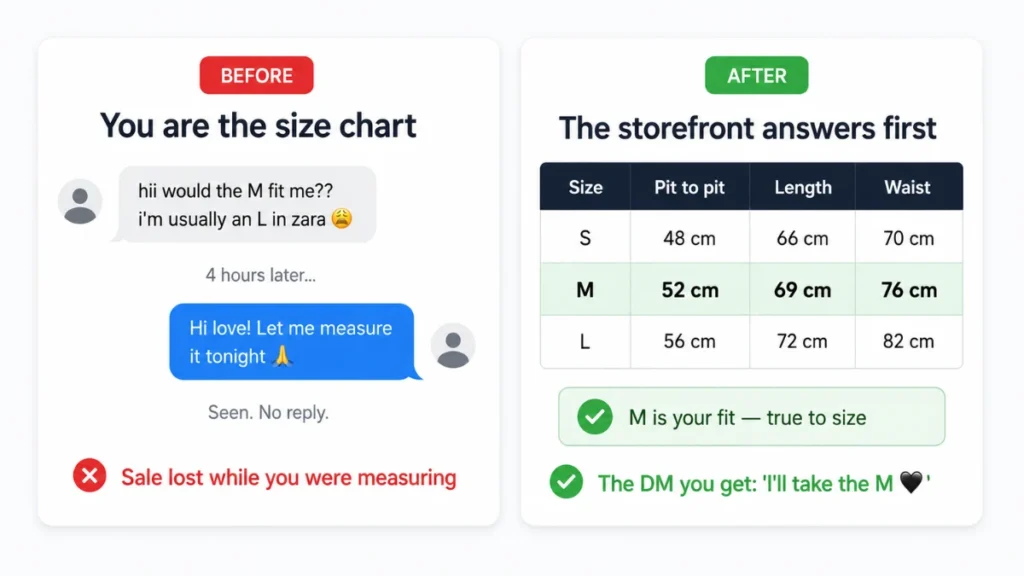
Death #1: The unanswered sizing question. A buyer asks “would the M fit me?”, you answer four hours later, the moment has passed. Fix: stop being the size chart. Publish real garment measurements for every piece — pit-to-pit, length, waist — somewhere buyers can self-serve. When your storefront carries proper size charts, “will it fit?” answers itself, and the DMs you do get are from buyers who already know their size and want to pay.
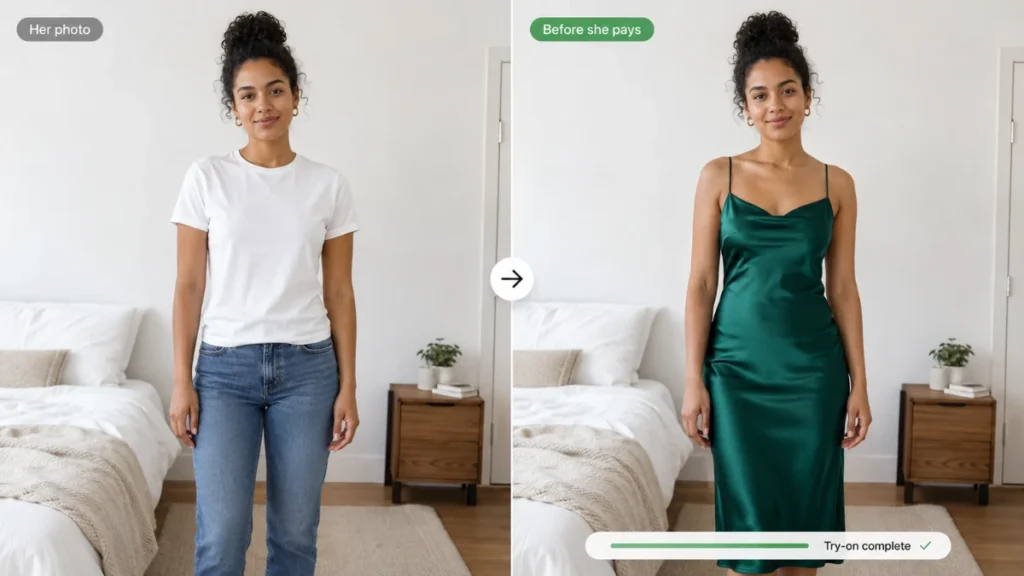
Death #2: The imagination gap. The piece looks great on your model (or your mannequin), but the buyer can’t picture it on themselves — so they save the post “for later” and never return. This is the single biggest silent killer of Instagram clothing sales, and it’s exactly what virtual try-on eliminates: the buyer uploads one photo of themselves and sees your actual garment on their actual body. The difference in buying confidence is dramatic — seeing yourself in the clothes is what turns “cute 😍” into “how do I pay?”. It’s also why try-on screenshots get shared to Stories, which markets your shop for free.
Death #3: The payment fumble. The buyer says “I’ll take it!” and you send your PayPal in a message they scroll past. Fix: have one payment routine and make it muscle memory — payment link, price confirmation, shipping cost, expected ship date, all in one message template you paste and personalize. Speed closes; friction kills.
Step 4: Post Like the Algorithm Is Your Landlord
You don’t need to go viral to sell clothes on Instagram — you need consistent reach into the right feeds. What works for selling accounts in 2026:
Reels for reach, carousel posts for closing. Short try-on videos, styling clips, and new-drop teasers find new audiences. Carousels with multiple angles and details convert the audience you already have.
Stories for urgency. “Two left in M” on a Story sells the piece the grid post couldn’t. Use countdown stickers for drops and polls to decide what to source next — engagement data doubles as market research.
Show your buyers. Repost customers wearing your pieces (and their AI try-on screenshots — with permission). Social proof from real bodies beats any product shot, and it costs you nothing.
Answer the comments in public. When someone asks about sizing or shipping under a post, answer there before moving to DMs — every public answer works on the next hundred people who read it.
Step 5: Kill Returns Before They Happen
Returns hurt Instagram sellers more than anyone: no automated returns portal, no restocking workflow, just awkward DM negotiations and re-shipping costs that erase the margin on three other sales. The two causes of nearly every clothing return are wrong size and “it looked different.” Both are preventable at the point of sale — measurements and try-on kill the first, and seeing the garment on their own body kills the second. We’ve broken down the numbers in our guide to reducing clothing return rates, but the principle for DM sellers is simple: every question a buyer answers before paying is a refund conversation you never have.
When You Outgrow the DMs
There’s a natural ceiling to DM selling — somewhere around the point where order tracking lives in your screenshots folder. When you hit it, you have two moves. If you want a full webshop with checkout, our virtual try-on plugin for WooCommerce brings the same fitting room to a store you own end to end. If you love the DM model and just want the friction gone, a hosted storefront is the lighter move: see how the Instagram version works here. Plenty of sellers run the storefront for years — the DM relationship is a feature, not a limitation. Your buyers trust the conversation; the storefront just makes sure the conversation starts with “I’d like to buy” instead of “what are the measurements?”
FAQ: Selling Clothes on Instagram
Do I need a business license to sell clothes on Instagram? That depends entirely on your country and volume — many places allow casual reselling but require registration once it becomes regular income. Check your local rules; this is the one part of the playbook nobody can shortcut for you.
How do I price for Instagram? Round numbers, stated up front, in the caption or the storefront — “DM for price” suppresses sales and annoys the algorithm’s favorite buyers: impulsive ones. Factor in your shipping, packaging, and the occasional refund before setting margins.
Can I sell clothes on Instagram without a website? Yes — thousands of sellers run entirely on Instagram plus a hosted storefront link. You get product pages, size charts, and virtual try-on without hosting or code. That’s exactly what AnyDress for Instagram sellers provides.
How many followers do I need to start selling? Fewer than you think. A thousand engaged followers in your niche outsell fifty thousand passive ones. Conversion infrastructure — clear pricing, sizes, easy ordering — matters more than audience size, because it determines how much of your existing audience actually buys.
What sells best on Instagram in 2026? Distinctive niches with clear identity: curated vintage, streetwear drops, modest fashion, plus-size basics, handmade pieces. The generic “boutique haul” account is the hardest version to grow — the algorithm rewards a recognizable point of view.
Ready to give your followers a fitting room? Open your virtual try-on storefront — live before your next post.