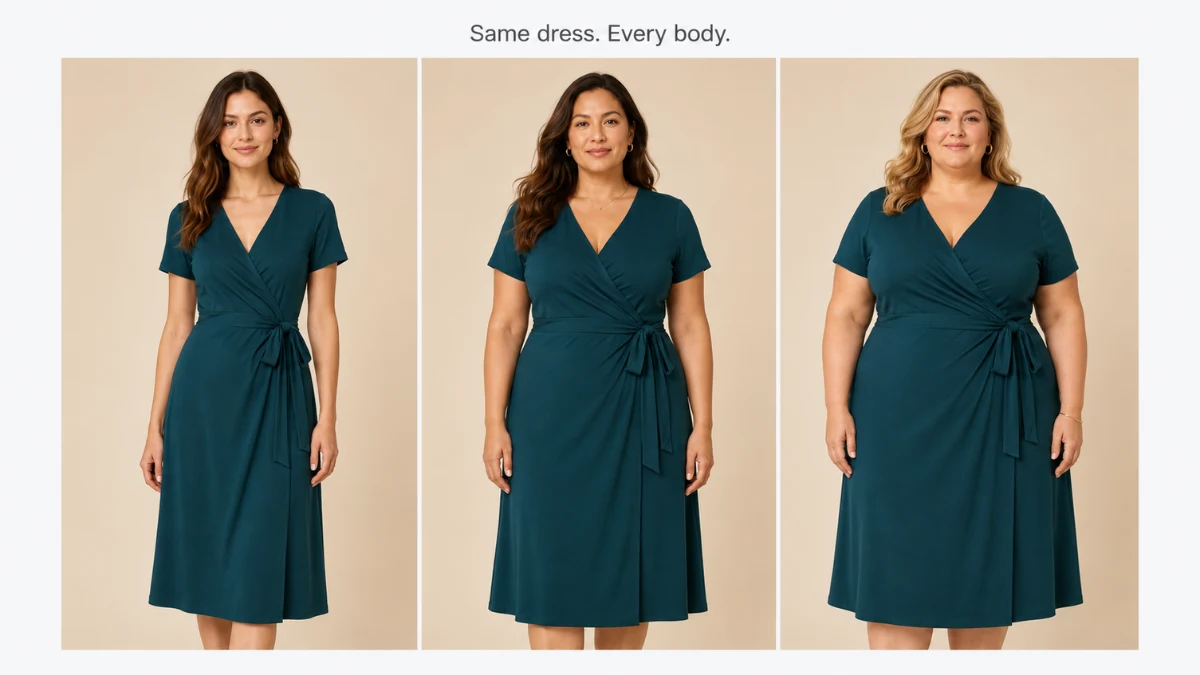
Ask plus-size shoppers about buying clothes online and you’ll hear the same story with different details: the dress photographed on a size-S model with clips at the back, the “XXL” that measured like an L, the size chart that stopped two sizes short of the range on the label, the return counter that has seen it all before. Online clothing retail is built on guesswork, and plus-size customers have been asked to do far more guessing than anyone else — with worse information.
Which is exactly why plus-size fashion is one of the best opportunities in independent e-commerce: an enormous, loyal, underserved market where the bar for earning trust sits embarrassingly low, and where the store that actually solves fit uncertainty doesn’t just get the sale — it gets the customer for years. Here’s how to be that store, concretely.
The Trust Deficit Is the Business Problem
Plus-size shoppers don’t abandon carts because they don’t want the clothes. They abandon because experience has taught them the risk: fit inconsistency across brands is worse in extended sizing (grading a design up is genuinely harder, and many brands do it carelessly), photography rarely shows the garment on a body like theirs, and every wrong guess costs a return, a re-order, and a little more faith in online shopping generally.
For you as the store owner, that means the competition isn’t really other boutiques — it’s your customer’s accumulated skepticism. Every element below is a trust repair, and they compound.
Show the Clothes on Bodies Like Your Customers’
The oldest complaint in the category: clothes photographed exclusively on straight-size models tell a plus-size shopper nothing about how the drape, the length, or the cut behaves on her. If your catalog shows one sample size on one body type, your photography is answering a question your customers aren’t asking.
This used to be an economics problem — shooting every piece on multiple models multiplies photoshoot costs, which is why only giants did it. AI product photography removed that constraint: from one garment photo, you can generate the same piece on models across the full range of body types and sizes you actually sell, consistently styled, at catalog scale. (The mechanics are in our guide to AI clothing photography without a model.) Two honesty rules make this work instead of backfiring: render the fit truthfully — if the fabric pulls at the hip on larger sizes, showing an idealized drape manufactures the exact “looked different” disappointment you’re trying to prevent — and disclose AI imagery plainly. Your customers have well-tuned radar for being marketed at; honesty is the aesthetic.
Publish Measurements Like You Mean It
A size chart that says “3XL: 22–24” is a label pointing at another label. What earns trust is garment-level data: actual bust, waist, hip, and length measurements per size, per garment, plus the two things extended-size shoppers specifically need and almost never get — fabric stretch (a measurement in a rigid cotton and one in a 4-way stretch knit are different facts) and where the garment is fitted versus relaxed. If your supplier can’t give you per-size specs across the extended range, that’s a red flag about how the grading was done — the same supplier-quality signal we describe in our AliExpress sizing guide, and doubly important here.
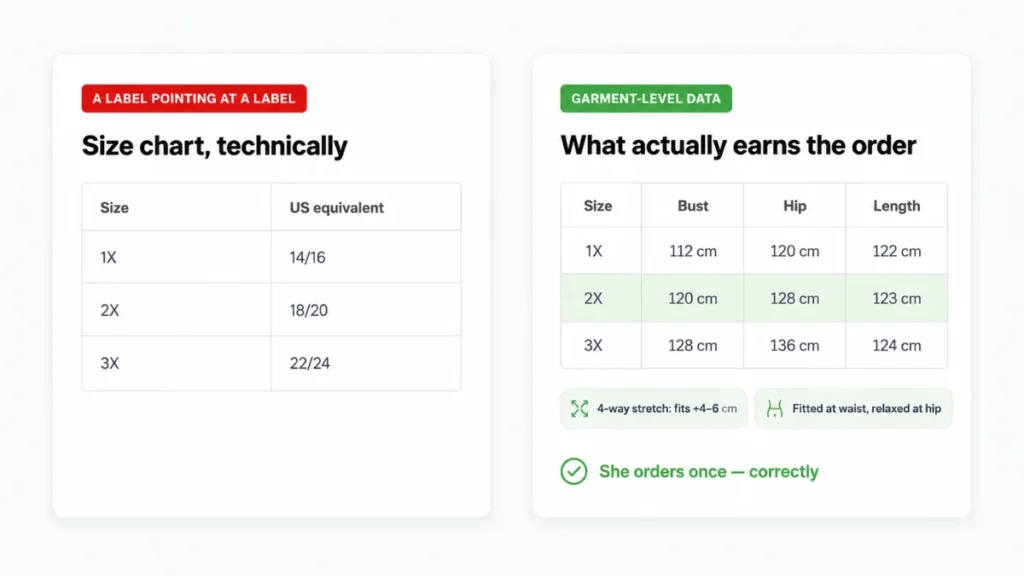
In WooCommerce, size charts with per-size garment measurements attach to products in bulk with per-product overrides — build them per garment type and cut, not one chart storewide, because grading differences between your suppliers are precisely what burns your customers.
Let Her See It on Herself
Representation in photography narrows the gap; virtual try-on closes it. The shopper uploads one photo and sees the actual garment on her actual body — not on a model chosen to approximate her, but on her. Paired with her measurements, the try-on can also flag honestly when a size will run tight and suggest the better one before checkout.
For most audiences we frame try-on as a conversion feature. For plus-size retail it’s something more specific: it’s the first time many of your customers have been shown themselves in your clothes before paying for the privilege of finding out. Stores in this category report the same pattern we’ve described in our returns guide — wrong-size and wrong-expectation orders drop when the guessing stops — but the second-order effect matters just as much here: try-on screenshots get shared, and in plus-size communities, “this store actually shows you” is the kind of recommendation that moves in group chats and gets a boutique adopted.
Respect the Details That Signal Whose Store This Is
Beyond imagery and fit data, plus-size shoppers read a store for signals of whether it was built for them or merely extended to include them. The details that answer “built for you”: extended sizes integrated in the main catalog rather than exiled to a “plus” ghetto category (offer a filter, not a separate store); product copy that describes fit behavior (“skims, doesn’t cling”, “true waist, relaxed hip”) instead of euphemisms; reviews with size-purchased shown; and a returns policy written in plain language — because your customers have been burned by fine print before. None of this costs money. All of it converts.
The Fit-Trust Audit
Walk your store as a skeptical first-time visitor and score it honestly:
- Does every product show the garment on more than one body type?
- Can a shopper find real garment measurements — with stretch noted — for the exact size she’d order?
- Can she see the piece on her own body before paying?
- Do your product descriptions say how it fits, not just what it is?
- Are extended sizes in the main catalog, one filter away, priced the same?
- Would your returns policy read as fair to someone who’s been burned twice this year?
Six yeses and your store is in rarer company than it should be — the plus-size customer who finds it will bring her friends. Most of the list is buildable this week: AI photography with a size-inclusive model roster, per-size charts, and virtual try-on for WooCommerce stores, or a hosted storefront with the same fitting room if you sell through Instagram without a website.