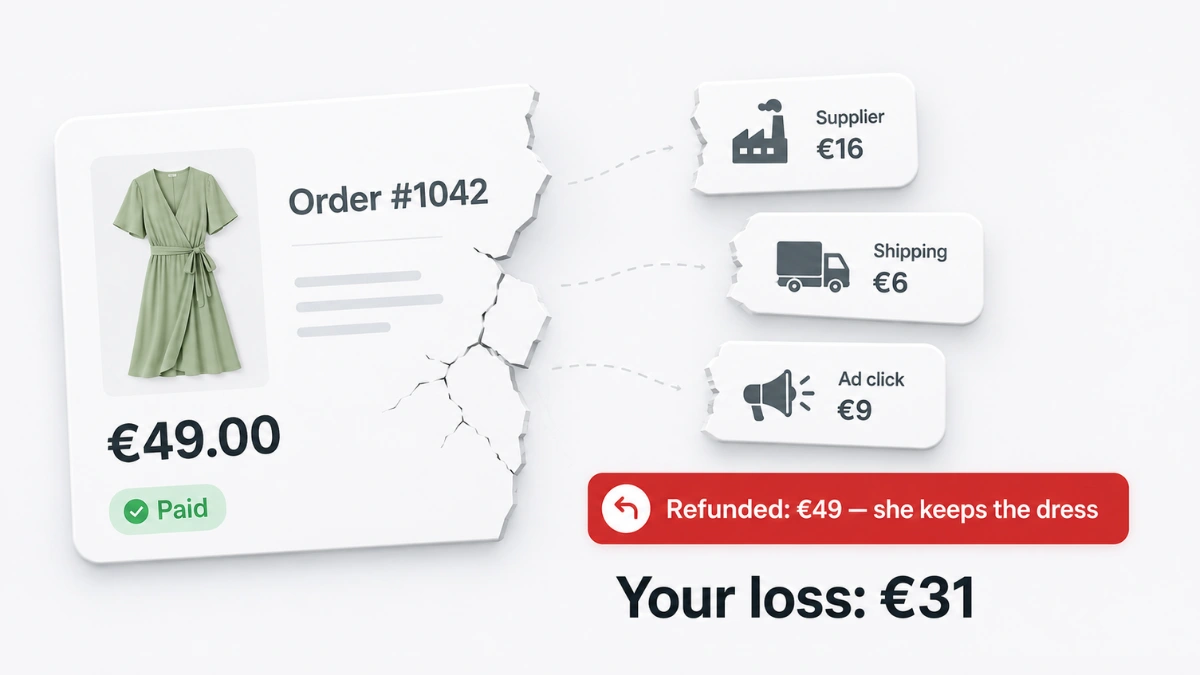
Run the math on one returned dress and the whole topic snaps into focus. Say you sell it for €49: you paid your supplier €16, shipping to the customer €6, and the ad click that produced the order cost you €9 in spend. Now she wants to return it. Shipping it back to your supplier in Guangzhou costs more than the €16 the dress is worth — and your supplier probably wouldn’t accept or restock it anyway. So you do what nearly every dropshipper does: refund the €49, tell her to keep it, and quietly absorb a €31 loss on an order you celebrated last week. Three of those wipe out the margin on ten good orders.
That’s the real shape of dropshipping returns: there is no returns process — there’s only a refund bill. Which means every hour spent perfecting your returns policy is spent managing the loss, and every hour spent preventing the return never pays the bill at all. This article is about the second kind of hour.
Your Returns Policy Is Damage Control, Not Strategy
To be clear: you need a returns policy — your payment processor, your ad platforms, and consumer law in most markets require one, and a missing policy page kills trust on its own. But understand what it can and can’t do. A policy determines how gracefully you lose money once a customer is unhappy. It has zero influence on how often customers become unhappy. For a store with domestic suppliers, those two things are closer together, because a returned item goes back into sellable stock. For a dropshipper, the gap is the whole game: gracefully handled or not, the money is gone.
So the strategic question isn’t “what’s the best dropshipping return policy?” — it’s “why do clothing orders come back, and how many of those reasons can I eliminate before checkout?”
Where Clothing Refunds Actually Come From
Clothing returns concentrate overwhelmingly in four causes, and each one has a prevention lever a dropshipper controls:
1. Wrong size. The dominant cause, and worst for dropshippers because Asian-manufactured sizing runs one to two label sizes off Western expectations — a problem so central we wrote it its own guide: AliExpress clothing sizes explained. The lever: publish real garment measurements per size instead of labels, and let shoppers check fit against their own measurements before ordering. With virtual try-on and size charts on your product page, the “will the M fit?” gamble — the single largest source of your refund bill — gets answered before checkout instead of after delivery. Every prevented wrong-size order is a full €31 saved.
2. “It looked different.” The expectation gap: supplier photos show one garment, three weeks later a subtly different reality arrives. Part of this is photo quality — covered in our guide to dropshipping product photos — and part is a photo-to-reality honesty problem you control completely: when you generate your own product imagery, keep the fit, color, and fabric behavior true to what ships. A gorgeous render that oversells a cheap fabric doesn’t prevent returns; it manufactures them. Letting the shopper see the garment on her own body closes most of what remains of this gap.
3. Quality surprise. The garment is what the listing said — the customer just expected more for €49. This is a sourcing and pricing problem, not a content problem: sample your bestsellers, drop suppliers whose output disappoints, and price so the unboxing over-delivers slightly rather than under-delivers. No tooling fixes a product that shouldn’t have been sold at that price.
4. The three-week remorse window. Long shipping gives buyers twenty days to cool off, compare, or forget. You shrink this with honest delivery estimates (surprise lateness converts directly into disputes), shipping notifications that keep the order alive in her mind, and — where volume justifies it — faster fulfillment routes for bestsellers.
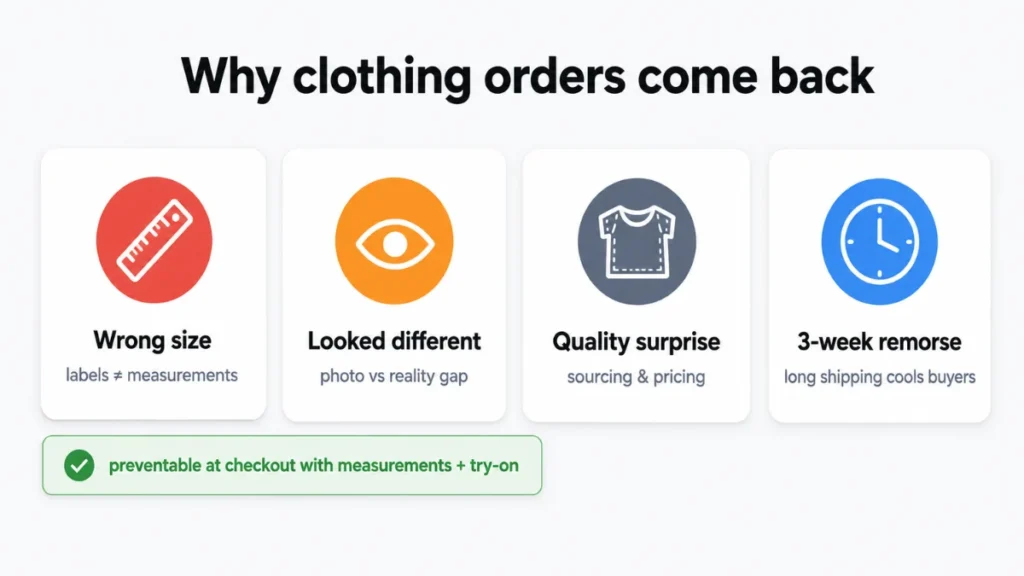
Notice the pattern: the two biggest causes are both information failures at the moment of purchase, which is why prevention tooling — measurements, fit-checking, try-on, honest imagery — attacks the majority of the refund bill at once. That’s the case laid out in numbers in our returns reduction guide.
What Should Go in the Policy Anyway
Since you must have one, make it a policy built for dropshipping economics rather than one copied from a store with a warehouse:
Refund without return below a threshold. If return shipping exceeds item value, demanding the item back is theater that costs you goodwill on top of money. “Keep it, here’s your refund” under a set value — communicated as generosity, not desperation — is standard practice among experienced dropshippers.
Ask for photos first. A photo of the sizing tag or the defect resolves most cases in one message, filters casual refund-fishing, and gives you evidence for supplier disputes — many suppliers will credit you for genuinely defective items if you document them.
Offer the exchange path prominently. For wrong-size cases, “we’ll send the L, keep the M” costs you one supplier price plus shipping — often half the cost of a refund — and keeps the customer. It only works if you learned the right size, which loops back to measurements.
State realistic timelines. Underpromise on refund processing the same way you should on delivery. Every day a refund is later than promised is a chargeback risk, and chargebacks cost fees plus your processor’s patience.
The Prevention Checklist
Before you spend another euro on ads, walk your store through this list — it’s the whole article in one pass:
- Every product shows real garment measurements per size (cm and inches), sourced from the supplier’s spec table — not just S/M/L labels.
- Bestsellers have been sample-checked: measurements verified, quality acceptable at your price point.
- Shoppers can check fit against their own measurements — or see the garment on their own photo — before checkout.
- Product imagery is yours, and honest: fit, color, and fabric match what ships.
- Delivery estimates on the product page are real ones, stated in days, not “fast shipping.”
- Your policy offers photo-first resolution, keep-it refunds below your threshold, and a prominent exchange option.
- You track why each refund happened — size, expectation, quality, remorse — because the category tells you which lever to pull next.
A store that clears this list doesn’t have a returns strategy problem, because it has structurally fewer returns. That’s the only version of this that protects a dropshipper’s margin — and it’s all buildable in an afternoon: size charts and virtual try-on for WooCommerce, honest imagery from the Virtual Photoshoot studio, and a policy page rewritten for the economics you actually operate under.