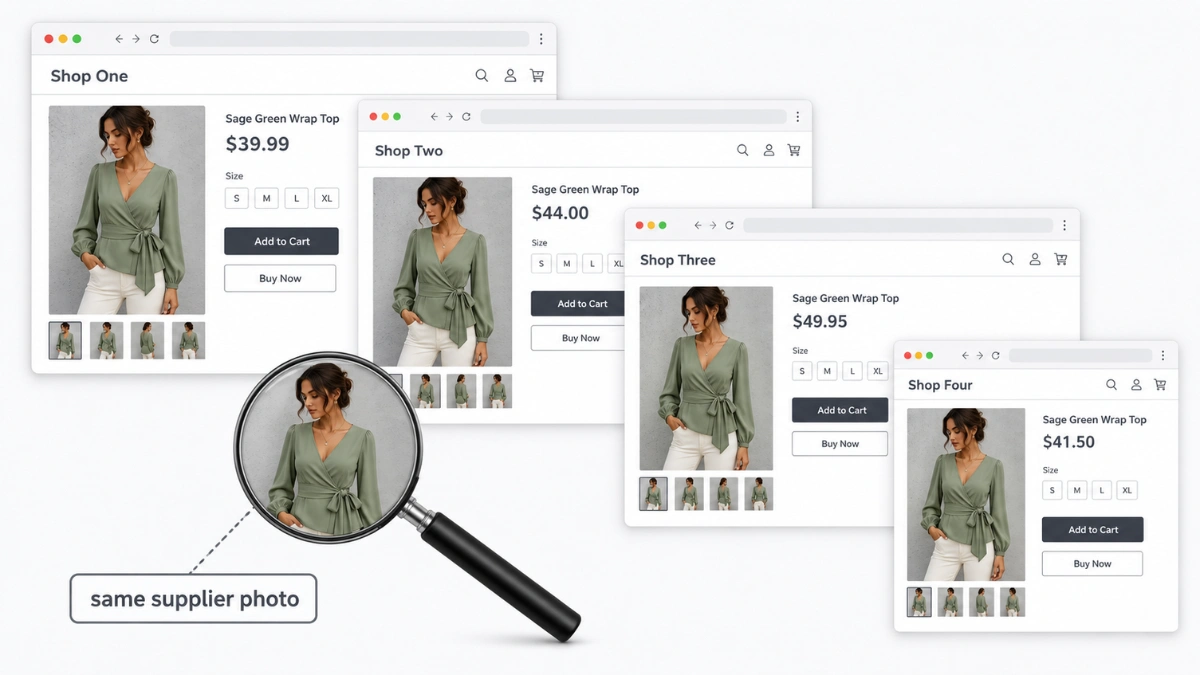
Shoppers can smell a dropshipping store in about two seconds, and it’s almost never the prices or the shipping times that give it away first. It’s the photos: the same over-lit supplier images, the same anonymous models against the same gray studio walls, the same shots they scrolled past on three other stores this week — and can reverse-image-search straight back to the marketplace listing you sourced from, at a third of your price.
This is the differentiation problem at the heart of clothing dropshipping. You can’t fix it the way normal stores do, because you never touch the inventory. But it has become fixable — and the stores fixing it are quietly separating themselves from the thousand clones. Here’s the honest picture.
Why Supplier Photos Are Killing Your Conversion
The photo problem compounds at every stage of the funnel:
Trust collapses on arrival. Shoppers have learned the visual signature of AliExpress catalogs. When your product page looks like one, they assume everything else that comes with it — month-long shipping, no returns, gambling on quality — whether or not that’s true of your store.
Your ads can’t differentiate. You’re bidding against other stores running the same product with the same creative. When the image is identical, the auction is decided purely on who pays more — a game the thinnest margin loses.
Price-checking is one reverse-image-search away. Unique images don’t just look better; they break the visual link between your $49 listing and the supplier’s $14 one.
No content flywheel. Real stores feed their grids, Reels, and email from their photoshoots. With supplier images, you have nothing to post that a hundred competitors aren’t also posting.
Your Actual Options (Honestly Compared)
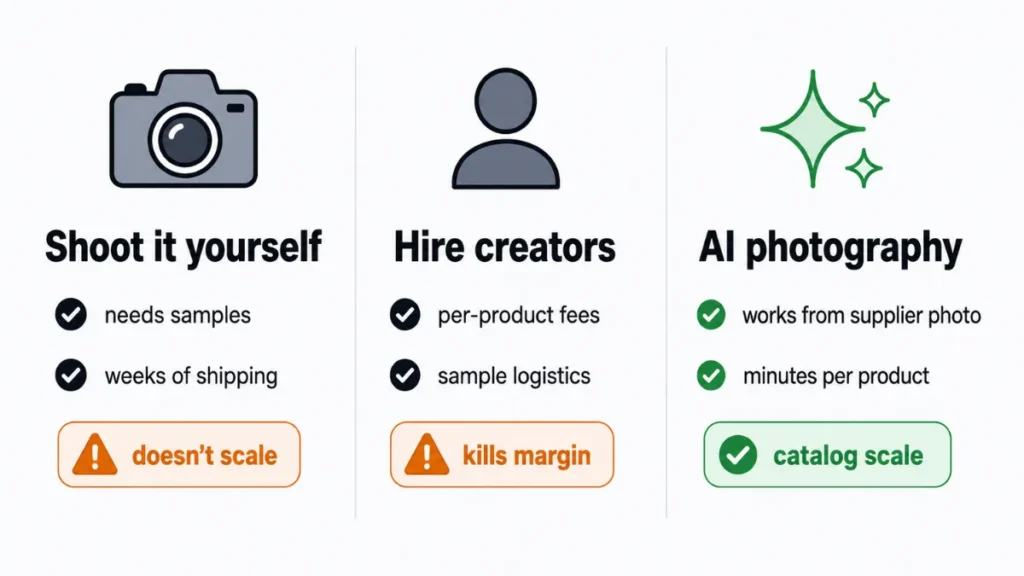
Option 1: Shoot it yourself. The standard advice — “order samples and photograph them” — is legitimate for a 10-product curated store and impossible at dropshipping catalog scale. A 200-SKU store would need 200 samples, weeks of shipping, and a photographer, at which point you’ve reinvented inventory, the thing dropshipping exists to avoid. Verdict: works only for small, curated stores treating dropshipping as a stepping stone to holding stock.
Option 2: Hire freelance photographers or UGC creators. Real quality, real cost: per-product fees plus sample shipping to the creator, multiplied by your catalog and by every seasonal refresh. The math kills it for typical dropshipping margins. Verdict: reserve for your 5–10 hero products, if anything.
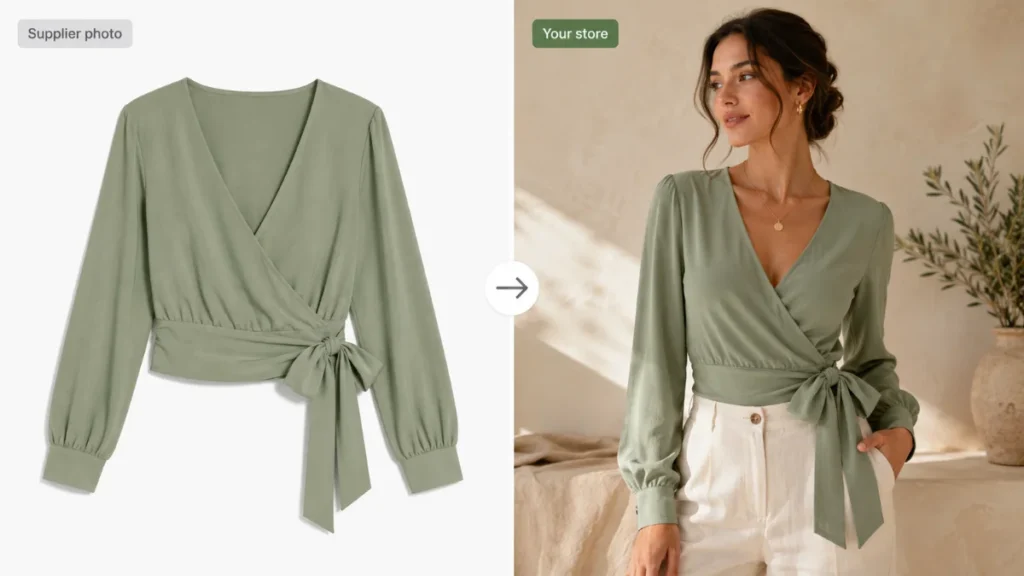
Option 3: AI product photography. This changed the equation. Modern AI photography tools take the supplier photo you already have — a flat lay, a packshot, even the supplier’s own model shot — and regenerate the garment on a new AI model, with your choice of model look, pose, background, and photography style. The garment stays the same; everything identifiable about the source image changes. One supplier photo becomes a full branded set: on-model shots, ghost mannequin versions, lifestyle scenes. No samples, no shipping, minutes per product. (The full mechanics are in our guide to AI clothing photography without a model.)
For a WooCommerce dropshipping store, this runs inside your dashboard: the AnyDress plugin’s Virtual Photoshoot studio pulls your existing product images and regenerates them in bulk — a consistent model roster and visual style across your whole catalog, which is exactly the “real brand” signal supplier photos can never produce.
The honest caveat: AI photography is only as good as the garment detail in the source image. A decent supplier packshot regenerates beautifully; a blurry 400-pixel thumbnail doesn’t. Test on your real catalog before committing, and regenerate your bestsellers first — that’s where the conversion lift concentrates.
The Second Layer: Fit Uncertainty Is Your Return Problem
Unique photos get the click and the trust; fit uncertainty still kills the margin. Dropshipping returns are uniquely brutal — when return shipping to a supplier costs more than the item, “returns” mostly means refunding and eating the loss. And clothing’s two return drivers, wrong size and “looked different on me,” hit dropshipping hardest: your buyers are cold traffic who’ve never worn your (supplier’s) sizing, which often runs a full size off Western charts.
The same category of AI that fixes your photos fixes this too: virtual try-on lets the shopper upload one photo and see the garment on her own body before ordering, and per-size garment measurement charts let her check fit instead of guessing. Every wrong-size order prevented is a full refund you didn’t eat. The numbers are in our returns guide — for dropshippers specifically, prevention isn’t an optimization, it’s the only returns strategy that works.
Selling through a bio link instead of your own site? The same fitting room exists as a hosted storefront for Instagram sellers and TikTok sellers — many dropshippers run exactly this way.
Staying Legal: Whose Photos Are These?
Worth addressing plainly, because most dropshipping guides skip it. Supplier photos come with murky rights: marketplace images may be the supplier’s, the manufacturer’s, or lifted from another brand entirely — and models in those photos never signed releases for your marketing. Using them exposes you to takedowns at exactly the moment a product starts working.
AI-regenerated imagery improves your position in two ways: the model in the image doesn’t exist (no likeness rights to violate), and the generated composition is created for your store rather than copied from a listing. It doesn’t launder a stolen garment design — source from suppliers whose products you’re entitled to sell — but it removes the copied-photo and model-likeness exposure that supplier images carry. If you’re using AI-generated models at scale, note that disclosure rules for AI imagery are tightening (the EU AI Act among others), so a simple “images AI-generated” note in your footer is cheap insurance and increasingly the norm.
A Realistic Workflow for a 100-Product Store
Day one: install the plugin, connect your catalog, regenerate your top 10 bestsellers with one consistent AI model and background style — bestsellers first, because that’s where traffic already lands. Week one: extend to the top 50, enable try-on and size charts on the bestsellers, and set your supplier’s real garment measurements per size (ask your supplier for the size table; most have one). Ongoing: every new product gets regenerated imagery before it goes live, and your ad creative pulls from your regenerated set — which now looks like nobody else’s store, because it isn’t.
FAQ: Dropshipping Product Photos
Can I legally use AliExpress product photos in my store? It’s risky. Rights to those images are rarely clear, the models never released their likeness to you, and takedown requests hit when a product succeeds. Generating your own imagery from the product removes most of this exposure.
How do I make my dropshipping store look like a real brand? Consistency is the tell: one model roster, one photography style, one background language across your catalog — plus your own domain, sizing information, and content made from your own images. Shoppers read visual consistency as “this store actually exists.”
Does AI product photography work from supplier photos? Yes — that’s the point for dropshippers. A reasonable-quality supplier packshot or flat lay is enough for AI to regenerate the garment on a new model in a new setting. Very low-resolution sources are the main failure mode.
Do product photos really affect dropshipping conversion? They’re the first trust signal a cold visitor evaluates, before price and before reviews. Identical supplier imagery marks the store as a reseller instantly; unique on-model imagery is the single most visible difference between stores that convert cold traffic and stores that don’t.
Your competitors are one reverse-image-search away from your supplier. Make your store the one that doesn’t match: see the Virtual Photoshoot studio for WooCommerce.