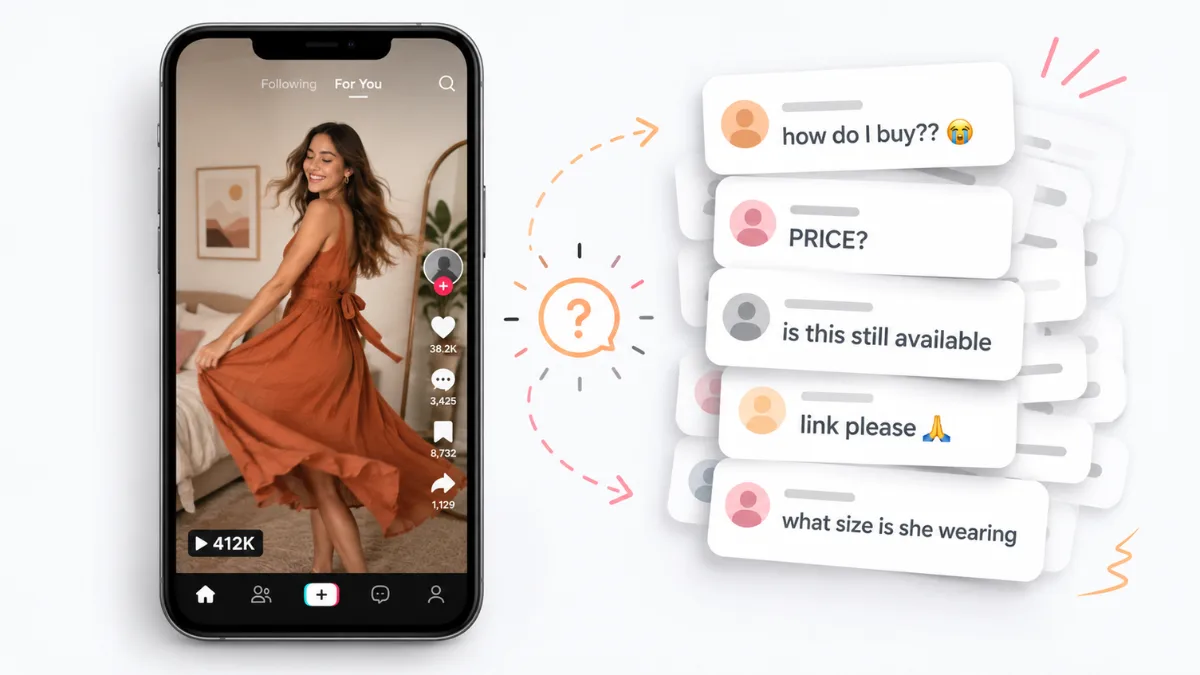
TikTok is the only platform where a clothing seller with 200 followers can wake up to 400,000 views. That’s the promise that pulls thousands of boutique owners, thrifters, and small brands onto the app — and it’s real. What the success stories skip is the other half: most sellers who get their viral moment convert almost none of it into orders, because the moment arrived before the infrastructure did. A hundred comments asking “how do I buy??” is not a sales channel.
This guide covers how selling clothes on TikTok actually works in 2026 — the content that sells, the TikTok Shop decision, and how to be ready for the spike before the algorithm sends it.
How TikTok Selling Is Different
On Instagram, people follow shops and browse them like catalogs. TikTok doesn’t work that way: nobody browses your grid, and your follower count barely matters. Every video is served cold to people who’ve never heard of you, judged in the first two seconds, and either amplified or buried. This changes the whole selling equation:
Discovery is free but unpredictable. You don’t build an audience so much as repeatedly earn one, video by video. This is why TikTok rewards sellers who post daily and punishes perfectionists who post monthly.
Attention arrives in floods. When a video hits, you get days — sometimes hours — of massive attention that then evaporates. Whatever buying path exists at that moment is the one that gets used. If your bio says “DM me,” you’ll spend your viral window answering the same three questions four hundred times.
The content IS the store. Viewers buy the piece they saw in the video, styled the way you styled it. Which means every video needs a frictionless path from “I want that exact dress” to an order.
The Three Video Types That Sell Clothes
You don’t need dances or trends. Clothing moves on TikTok through three repeatable formats:
1. The try-on. You (or anyone) putting the piece on, on camera, with honest commentary — “this runs small, I sized up” outperforms polished ads because it answers the buyer’s real question: what does this look like on an actual body? Fit checks, “styling one skirt three ways,” and haul formats are all variations of this.
2. The transformation. Before/after is the most native storytelling structure on TikTok. For sellers: the thrift flip (grimy find → steamed and styled), the packing video (order → wrapped parcel), and — if you use AI product photography — the flat lay becoming a studio shot, which doubles as a demo of how your store looks. We break down how that works in our guide to AI clothing photography without a model.
3. The behind-the-scenes. Sourcing hauls, inventory days, “come thrifting with me,” reacting to your own sold-out drop. These build the parasocial trust that makes someone buy from a person instead of a marketplace — the one advantage a small seller has over Shein.
The cadence matters more than the polish: sellers who win post 4–7 times a week, film on their phone, and treat any video under 30 seconds of effort as content. If producing product visuals is your bottleneck, that’s a solvable problem — more on that below.
Do You Need TikTok Shop?
TikTok Shop is the platform’s native checkout — buyers purchase without leaving the app. For some sellers it’s the right call, but it isn’t the default answer it appears to be. Consider honestly:
TikTok Shop makes sense when you’re in a supported country, you can meet its seller verification requirements, you ship at volume, and you’re comfortable with the platform taking its commission and controlling the customer relationship — you often can’t even message your buyers off-platform.
It doesn’t fit when you’re outside the supported regions (a huge share of the world’s sellers are), you’re a small operation that can’t absorb marketplace fees and strict fulfillment SLAs, or your model depends on the personal relationship — the DM conversation, the repeat buyer who messages you first — that a marketplace checkout erases.
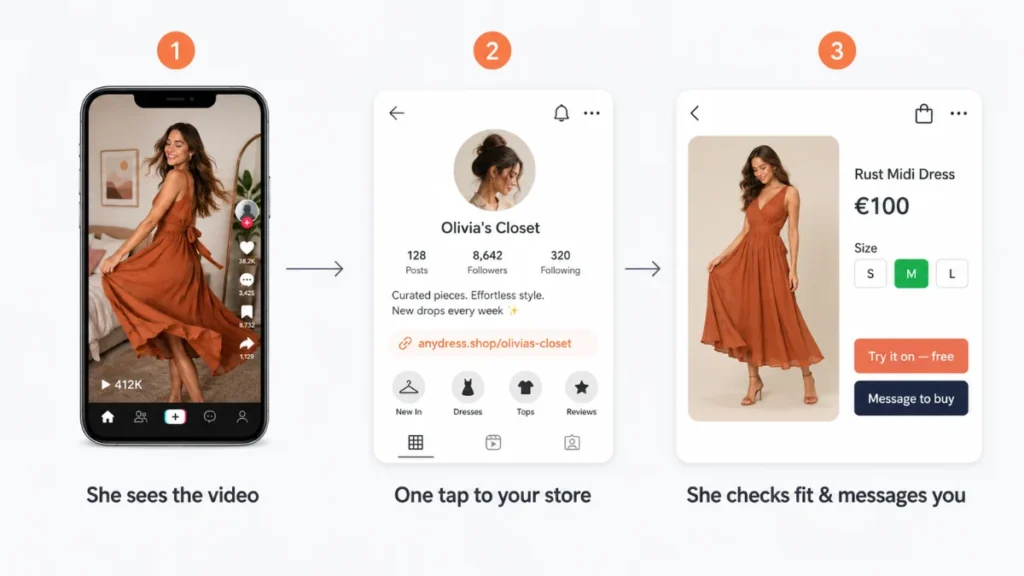
The alternative isn’t “build a website.” A hosted storefront gives you the missing piece — a link where viewers can browse your pieces, check real size measurements, and even virtually try clothes on — while keeping the sale itself in your DMs, where your margin and your customer stay yours. That’s exactly what we built for TikTok clothing sellers at AnyDress: no approval process, no country restrictions, no commission, live in minutes.
Solve the Landing Problem Before You Go Viral
Here’s the exercise that separates prepared sellers from lucky ones: open your own profile as a stranger and simulate the viral moment. A viewer just watched your dress video. She taps your profile. What happens next?
If the answer involves scrolling your videos hoping to find a price, commenting “how much?”, or DMing into a queue behind eighty other people — you’re leaking nearly everyone. What she needs is one tap: bio link → the exact piece → price, measurements, and a way to see it on herself → a message to you that says “I want this one” instead of “is this available?”
That last step deserves emphasis, because it’s clothing-specific: the number one killer of cold-traffic clothing sales is fit uncertainty. She’s never heard of your brand, doesn’t know your sizing, and won’t gamble €50 on a guess. Publishing real garment measurements handles half of that; letting her upload one photo and see the piece rendered on her own body handles the rest. It’s also why try-on results get screenshotted and shared — which, on TikTok specifically, means your buyers’ reactions can become your next video. (The mechanics of how this cuts return rates are in our returns guide.)
Live Selling: The Underrated Channel
TikTok LIVE is the closest thing to a market stall the internet has: you hold pieces up, viewers claim them in the comments, sales happen in real time. Sellers doing weekly lives report their most loyal-buyer revenue comes from there. The playbook is simple: schedule it (same day, same time, weekly), show 15–30 pieces, let scarcity work (“one M, first claim gets it”), and have your storefront link pinned so claimed pieces can be paid for without you juggling payment DMs mid-stream. LIVE requires meeting TikTok’s follower threshold, so it’s a phase-two channel — but it’s worth building toward.
The Content Volume Problem (and the AI Answer)
The math of TikTok selling is brutal: 4–7 videos a week, every week, plus product visuals for every new piece. Solo sellers burn out here — not on selling, but on producing. This is where AI product photography quietly changes the economics: one phone photo of a garment becomes a studio-quality image on a model, a ghost mannequin shot, or a styled scene — usable in your storefront, your videos, and your photo-mode carousels. The transformation itself (“watch this hanger shot become a photoshoot”) is native TikTok content. You stop choosing between filming and photographing, because the photographing takes minutes.
FAQ: Selling Clothes on TikTok
Can I sell clothes on TikTok without TikTok Shop? Yes — through the link in your bio, pinned comments, and DMs, backed by a storefront where buyers browse and check sizing. This is how sellers outside TikTok Shop’s supported countries operate, and how many inside them choose to keep their fees and customer relationships.
How many followers do I need to start selling? None, functionally. Discovery on TikTok is per-video, not per-account — sellers regularly make their first sales from their first viral video at double-digit follower counts. Follower thresholds only gate specific features like LIVE.
What about the link in my bio? Link availability depends on your account type and region, and TikTok’s rules there change periodically. Where the bio link isn’t available to you yet, pinned comments and video replies pointing to your store name work — make your storefront address short and memorable enough to type.
Do I need to show my face? No. Hands-and-product videos, voiceover styling videos, and transformation formats all sell without a face on camera. Face content builds trust faster, but plenty of successful sellers never show theirs.
What sells best on TikTok in 2026? Pieces with a visible hook: dramatic silhouettes, transformations, unusual fabrics, strong before/afters, and anything with a story (“found this 90s leather jacket in a bin in Milan”). TikTok is a video platform — clothes that do something on camera beat basics every time.
Getting views but not orders? Give your viewers somewhere to land: open your virtual try-on storefront — live before your next video.